Showing posts with label Naval. Show all posts

Sunday, 6 May 2012

A Return to Action

It's been quite quiet here at A-history Central recently, what with me moving house and everything. But there's been a bit of movement on the Damn Battleships front, including a new table mat and a couple of battles between perfidious Albion and la belle France.

Having played the French, I'm a bit gutted that they lost both times, but DBSA gives a fun, fast game. Neither Iskander or I are bona fide knowledgeers on the period (1890-1905), but he's done well wielding the might of the Royal Navy against la Republique. Our tactics have been pretty blunt (charge!, mostly), but his ships have come through unscathed pretty regularly, while my own have taken horrific casualties.

I was pleased, however to sink the HMS Euryalus in my last game. She was the queen of the battlefield in her maiden voyage, sinking destroyers, cruisers and battleships with abandon.

My only kill, but still. Here she is, the Lady of the Match:
Just before her sinking. Crippled, heavily damaged, but still floating.

I enjoy DBSA, and I'm thinking adding a Russian fleet to go with a colonial project (either DBA-Hx or Volley and Bayonet) based on an Indian front in the Russo-Japanese War.

Hopefully I'll have more regular posts with more pictures now I'm in the new casa.

Sunday, 11 March 2012

Damn Battleships Ahead!

I have a rule that I try (and fail) to stick to. When attracted, magpie-like, to a new period or army, I refrain from any purchases for a month or so to make sure I'm actually interested.

I've been looking at Navwar's 1/3000 Pre-Dreadnought range for some time now, for a fantasy project as much as anything else. I finally bought them very recently, and may I say Holy Cow in regards to Navwar's service. I posted them an order form and a cheque on the Monday (second class!) and received my packet Thursday morning. It wasn't just Pre-Dreads, I've picked up some Roundway 15mm Jacobites & British for playing Sharp Practice too.

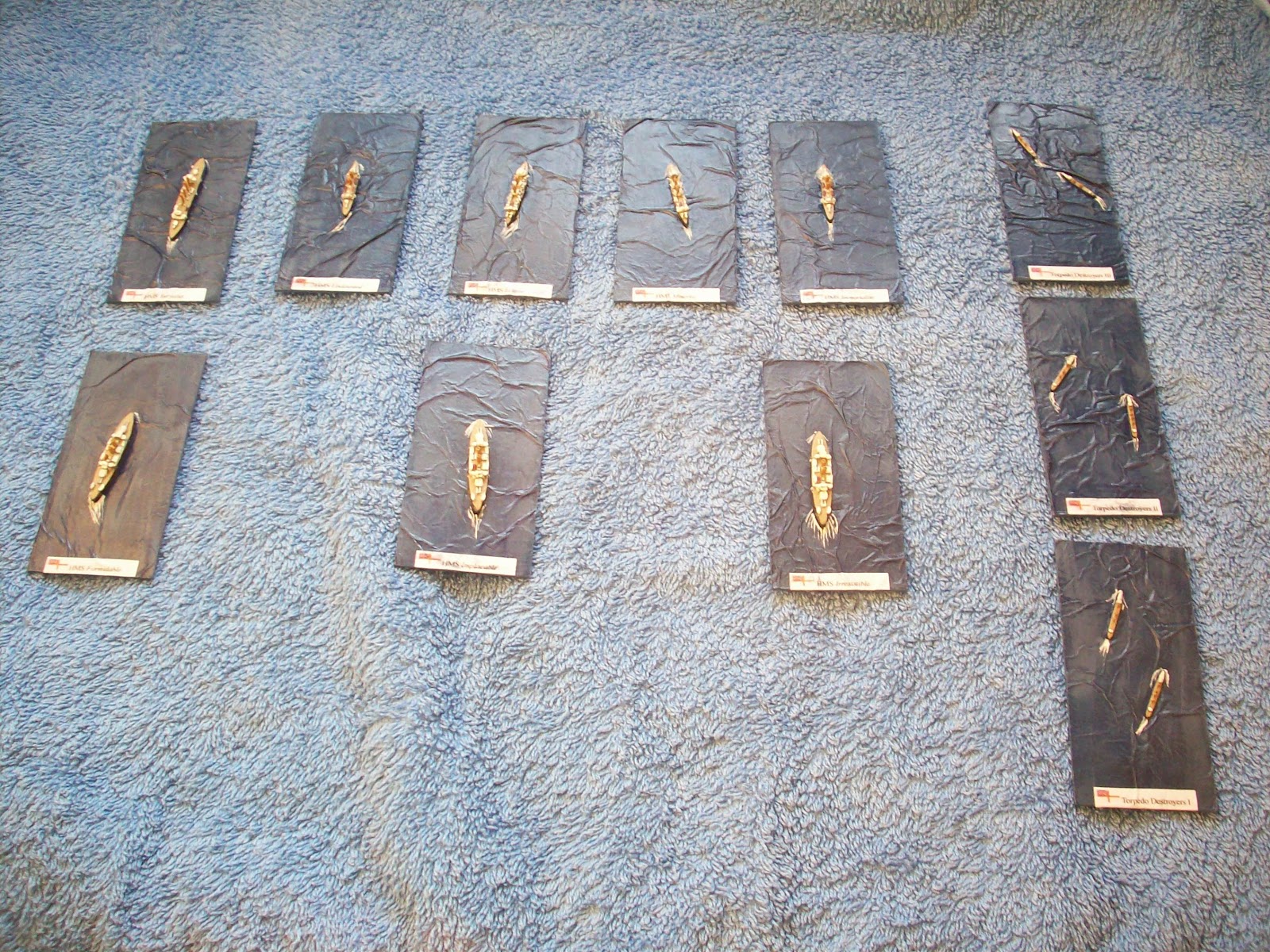
Anyway, it was Phil Barker's Damn Battleships Again that got me interested in the Pre-Dreadnought period, since my group is familiar with the DBx mechanics and it will be easy to stat up fantasy fleets. I was going to split Navwar's starter pack between real and imagi- nations, but I got carried away with my British. Bear in mind that this is only about two thirds of the £10 starter pack - Navwar really is amazing value for money. So without further ado, the beginnings of my Royal Navy. Three battleships, five cruisers and three pairs of torpedo destroyers. Click on the photos for larger versions.

Cruisers top, destroyers to the right, battleships at the bottom.

Cruisers top, destroyers to the right, battleships at the bottom.


Painting Guide: The bases were done by crumpling tissue paper from a flower shop and gluing it to plasticard. Once the ship was stuck on, the whole thing was undercoated with grey car spray.
Ships: GW Charadon Granite hulls, GW Kommando Khaki decks, Vallejo Off White armour/guns and GW Dark Flesh lifeboats.
Sea: GW Regal Blue with a drybrush of GW Shadow Grey, which was also the colour of the trim. This was followed up by a clear coat of Pledge.

The ships look awfully nice in person, but I haven't quite found a way to show that with my funny little camera yet.

As soon as I find another suitably large sea surface (I foolishly made my bed with the usual sheet), an AAR will go up - British vs French. I recall something of a crisis during the reign of Edward VII when a failed assassin in Paris was found to have used a bomb of Birmingham manufacture...

Friday, 24 February 2012

Pirates Ahoy!

We had a game of It Is Warm Work again on Wednesday, and it was great fun. Eight British ships lined up against eleven Spanish and Pirate vessels, determined to gain evidence of Spanish iniquity and collusion in the pirates' devastating raids.

And they got it! They all died, but they got it! Two British ships were sunk, two fled, two struck and two were reduced to burning hulks. Two pirate ships were successfully boarded, one sunk and the flagship was routed, but all in all a crushing victory to the Pirate faction.

The lines of battle meet - Spanish and Pirates in foreground, British in the distance.


As often happens though, things were closer than the results suggest. Barbarossa was a lot cleverer about using the wind than I was, and had the pirates not held tactical initiative for a solid eight turns after contact was made, things would have been very different. But so was war always.

Since Barbarossa took the pictures, they'll have to wait until I get them off him (if ever), but here's hoping!

Sunday, 5 February 2012

It's Warm Work Playtesting 'It Is Warm Work'

Having tried out Grand Fleet Actions In The Age of Sail, I decided to try a set that involved throwing more dice for damage – maybe it's a throwback to my GW days, but I much prefer the feel of a system that uses 3+ dice to one that relies on one die with modifiers. A lava lamp for gamers is what someone on TMP called it, but you can't deny that a Force on Force attack has a more engaging feel than a DBA one.

So anyway, what set did I pick? A mix of good reviews and cheap price led me to It Is Warm Work, a naval set by Frank Capotorto, and published by Crookedhead Games. The name comes from a quote of Lord Nelson's, spoken at the Battle of Copenhagen: “It is warm work; and this day may be the last to any of us at a moment. But mark you! I would not be elsewhere for thousands.”

IIWW is a simple system, with very little record-keeping (score!), variable number of dice depending on weight of broadside (score!), and with a fair bit of period flavour with windage, fouling, critical hits and boarding actions all accounted for (score again!).
It all sounds good on paper, but how does it play? Ahead of my Navwar arriving, I whipped out the old Pirates of the Spanish Main ships for a quick match-up between British and US forces. The US, under Commodore Johnson (I watched Blazing Saddles last night), had four ships – the 74s Albany and Kentucky, the 50-gun frigate USS James Madison and the garishly painted USS Vermont. I broke one of her masts assembling her, so I think I'll be binning her.
Seriously, Wizkids? That's awful.
Archangel turned up right before the game, and being a huge Hornblower fan, he opted to join in, taking the part of the Royal Navy's three ship squadron – HMS Royal 74, HMS Lord Walpole and Concorde 64s.

The game started slowly, with both flags in the van. They crossed quickly and started the Albany's run of bad luck with a terrific exchange of fire. The Kentucky made up for it by grappling and boarding the Concorde. Unfortunately, they couldn't get their grapples unhooked for ages, which took them out of the battle for ages. Luckily the Royal hung around waiting for them to unhook so that she could destroy them without hurting her sister ship, which left the Albany and both frigates to take on the Lord Walpole without interference.
And lucky it was, because the Lord Walpole turned out to be death machine. With exquisite gunnery and sailing, she chased down and sank the Albany – nearly destroying both frigates into the bargain.
It all looked like a wrap-up for the Royal Navy until the Kentucky got loose and unleashed three devastating broadsides against the Royal, sinking it completely with rolls on the critical hit and ship's fate tables. At the same time, the last dregs of the Madison and Vermont's gunnery crews stiffened their sinews and blasted the Walpole with such a shocking volume of fire that she struck her colours.

A bloody bash all told then, with both flagships, the Albany and Royal, sunk. Both of the other Royal Navy vessels had struck their colours after severe batterings, and the American squadron had taken an awful pummelling as well.

So what do I think of It Is Warm Work? I really liked it. It has minimal book-keeping, but with a lot of period flavour nonetheless. All the rules for fouling, grappling, boarding et al make a lot of sense, and it all flows very naturally just with the QRS. For three quid and twenty-eight pages, you can hardly ask for more! It's actually easier to play than Grand Fleets and has a lot more character too. Then again, it is designed only for 1740-1815 rather than 1530-1830, but since SYW and Napoleonics are my prime interest in this area it's not a great loss.

Man of the Match: The Kentucky, which took the Concorde and sank the Royal.
Un-men of the Match: The Madison and Vermont. They spent valuable turns fouled with each other, being ridiculous. Idiots. At least they finally blasted the Lord Walpole into submission.

EDIT: Having done some idle e-Bay research, I've found that it will actually be cheaper to build fleets in 1/3000th metal than from Wizkids' Pirate ships. Impressive work, Navwar!

Thursday, 2 February 2012

Grand Fleets of the Spanish Main

Well, I decided to splurge the £6.32 to buy Grand Fleet Actions in the Age of Sail from Wargames Vault, and how to playtest it except with old Wizkids Pirates of the Caribbean clip miniatures!
The excellent Admiral Whelphwood led a veteran squadron of four '74s and his flagship, the 90 gun Wycliffe against Admirale Jeanot's smaller average squadron of the Marie Antoinette 120 guns, the 110 gun Le Breton and La Geographe and the frigate Marianne.
Whelphwood's Squadron

Jeanot's ships


The first thing I realised was that my Wizkid card ships are bizarre! The French ships are just... odd, and the “card scale” size of the British was a mindscrew, but whatever – the ships aren't the point!

Grand Fleet is a simple system – a few d6, a few d10 and you're golden. So out they come. The system is pretty easy – commanders roll for initiative and then pick whether to move their ships first or second. From then on they take turns until all ships have moved, or a cataclysmic explosion destroys a ship. No-one can ignore a noise and a sound that horrifying!

Initiative swapped a fair bit for the first few turns of manoeuvring, until suddenly the HMS Wycliffe found itself bearing down on the frigate Marianne. Shooting is performed by rolling a d10 and adding relevant modifiers (ship's Gunnery, crew's Quality, circumstantial things). With a Gunnery of nine and a veteran crew, Wycliffe can do some real damage. Unless it rolls a one. When it does nothing. Marianne's return fire was equally desultory, and the turn ended with both squadrons closing in.
Whelphwood's Squadron in two lines.

Jeanot kept the initiative, and the Marianne swept away from the Wycliffe. The French line took her place, but was out of range until Whelphwood drove his squadron forwards. The Wycliffe and the Marie Antoinette opened up on each other, and the French flag lost some guns to accurate British fire.
Inspired by their first round of cannon, Whelphwood moved his squadron onwards. His line split to bracket the Marie Antoinette with fire, but didn't do an amazing amount of damage.
Wycliffe and Duke of York split to bracket the Antoinette

The Antoinette blasted the Wycliffe again, but the return fire from Wycliffe and the Duke of York nearly rendered it to a hulk, and in the next turn, actually did so, zeroing its Hull and Speed factors. Now barely afloat and devoid of masts, its crew had to test Morale (another d10 test), but courageously decided to fight on.
Leaving the near-crippled Antoinette to its own devices, Whelphwood's ships moved on to Le Breton and La Geographe. In a brutal exchange, they wrecked Le Breton's sails and gun decks. Further down the line, Plantagenet was lucky to have a weak exchange of fire with La Geographe. The Duke raked Le Breton from the stern and weak fire was thrown out by the other, far more battered ships.
The terrible crush.

Suddenly, as the Duke fired again, Le Breton went down in a blaze of lead. Even as she did, Whelphwood's second line bracketed La Geographe and opened fire. With a third of Jeanot's line of battle foundered, Whelphwood's surrounded La Geographe in a risky manoeuvre (which in hindsight I will not repeat). 

Geographe struck her colours under the weight of fire, and I called the game there. The Wycliffe was limping, the rest of Whelphwood's squadron relatively unharmed. One of Jeanot's ships was sunk, another had struck its colours, his flagship was a drifting wreck of splinters, and the Marianne escaped unscathed to bring France tales of its woe.
La Geographe, surrounded.

All in all, I enjoyed the game, and I think that with more reading it will do very well for fleet games. For squadron ones it is maybe a little abstract, but since I hate having to do a lot of recording keeping and chit-using in a game, that's fine by me really. The rules also have a section on fouling which I lazily avoided by keeping a nominal half-unit between all boats at all times.

The next step is to get some Navwar 1/3000 ships so I needn't rely on these bizarre (if charming!) monstrosities!